
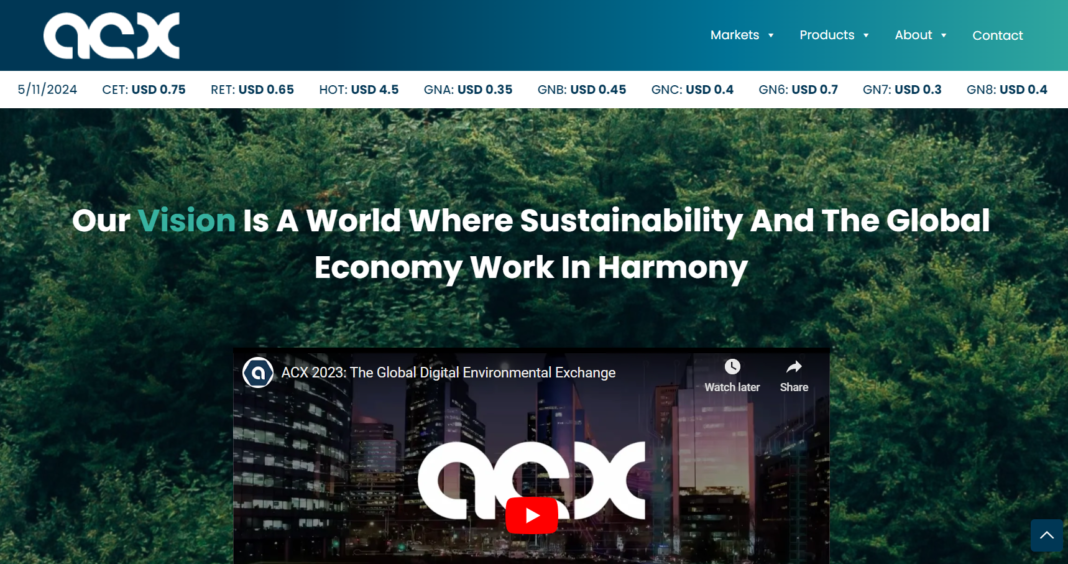


ACX, formerly known as AirCarbon Exchange, provides digital infrastructure for environmental markets. Its platform connects buyers and sellers of carbon credits and other environmental instruments. The aim is to make trading, pricing, and settlement more efficient.
However, an efficient exchange cannot make a weak carbon credit credible. Buyers still need to assess the project, standard, registry, and claim. Therefore, ACX should be understood as market infrastructure, not a quality guarantee.
What is ACX?
ACX is a digital environmental exchange that began as AirCarbon Exchange. According to the company’s official history, the platform launched in 2019 after early work in Singapore.
The exchange first focused on credits linked to international aviation. It later added a wider range of environmental instruments. In 2023, the business adopted the shorter ACX brand.
How ACX carbon trading works
A carbon exchange brings buyers and sellers into a common trading system. Users can view contracts, place orders, and complete trades. Standard contracts make different units easier to compare.
After a trade, the platform handles settlement and ownership records. As a result, buyers and sellers do not need to manage every step by email. Digital systems can also improve price visibility.
What does ACX trade?
ACX lists contracts linked to environmental instruments. These can include carbon credits and renewable energy certificates. Each contract has its own rules for project type, standard, date, or region.
Still, a contract name cannot capture every quality issue. Two credits may represent one tonne each but carry different risks. Buyers should examine the assets behind the contract.
Why exchanges matter in carbon markets
Voluntary carbon trading has often relied on private deals. That model can make prices hard to compare. Meanwhile, several brokers may charge fees at different stages.
Exchanges can bring more consistent contracts and visible prices. They may also speed settlement and improve records. Our guide to carbon exchanges explains this market role in more detail.
Benefits of the ACX model
- Price discovery: bids and offers can reveal current market demand.
- Standard contracts: common terms make trading easier.
- Faster settlement: digital systems can reduce manual work.
- Wider access: one platform can connect users across regions.
- Clear records: trade and retirement data can support audit trails.
These benefits focus on how the market operates. However, climate value still depends on the rules behind each credit and the way buyers use it.
Key risks buyers should check
Credit quality
A credit should represent a real and additional emissions cut or removal. It should also address reversal and leakage risks. Therefore, buyers must review the project method and evidence.
Market liquidity
Some contracts may trade often, while others attract few buyers. Low activity can create wide price gaps. In practice, users should check trading depth before placing large orders.
Settlement and custody
Buyers should understand how the platform records ownership and retirement. They should also know which registry holds the underlying credits. Clear links between systems reduce double counting.
Claims and greenwashing
Buying a credit does not erase the need to cut direct emissions. A company can still make a misleading claim after a valid trade. As a result, claim wording needs as much care as asset selection.
How ACX fits the wider market
ACX is one part of a larger carbon-market system. Project developers create credits, standards set methods, and registries issue and retire units. Ratings firms and auditors may add further checks.
The exchange provides the trading layer. Our carbon markets guide explains how credits differ from compliance allowances and why that distinction matters.
A buyer’s ACX checklist
- Check the contract. Understand the standard, project type, date, and region.
- Review credit quality. Test additionality, permanence, and the baseline.
- Assess liquidity. Look at available prices and trading depth.
- Confirm ownership. Trace the unit through the relevant registry.
- Retire the credit. Keep proof that it cannot trade again.
- Use careful claims. Explain the credit’s role without overstating it.
The bottom line
ACX brings digital trading tools to environmental markets. It can improve access, price discovery, contracts, and settlement for carbon-market users.
Yet exchange efficiency is only one part of integrity. Buyers must still check the credit, registry, market risk, and public claim before they trade.