


AI governance gives climate teams a clear way to control risk. A model may forecast floods, track carbon, or rank green projects. Yet even a useful model can cause harm when no one owns its choices.
That risk grows when AI shapes loans, insurance, public aid, or power systems. A wrong forecast may steer funds away from people who need help. Poor data may also make a sound model fail in a new place. Clear rules must guide the system from its first design to its final day of use.
What AI governance means
AI governance is the set of roles, rules, and checks that guide an AI system. It starts when a team defines the task. Then it covers data, tests, launch, live use, and final shutdown.
In practice, good rules help teams move with more trust. They show what the tool may do, who can approve it, and when staff must stop it. The NIST AI Risk Management Framework offers a useful base. In particular, it asks teams to govern, map, measure, and manage AI risk.
Six ideas should guide climate AI:
- Clear ownership: A named person owns the system and its results.
- Open records: Teams record the data, tests, limits, and approved uses.
- Fair results: Tests check for harm across groups, places, and firm sizes.
- Data care: Staff protect personal and sensitive data.
- Safe use: Teams find likely harms and set firm limits.
- Human review: People can question, change, or stop major decisions.
However, these ideas may pull in different ways. For example, an open record may expose private data. Meanwhile, a fairness rule may change how well a model works for some groups. A review team must weigh these choices and record why it chose a path.
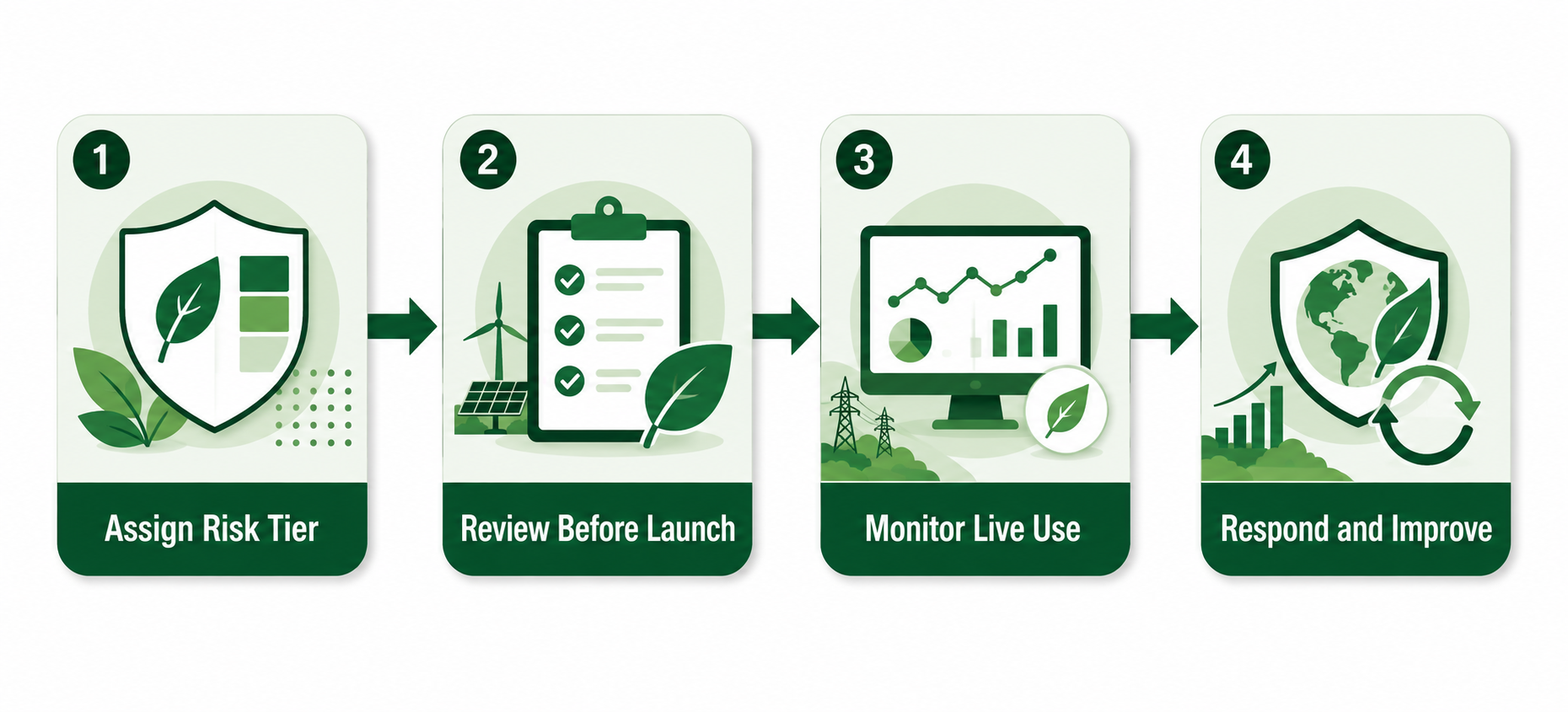
Use risk tiers to set the level of review
Tools need different levels of review. A risk tier helps a firm spend time where harm could be high.
Tier one covers routine support. A tool may sum up public reports or sort open data. Basic records and access rules may be enough.
Tier two covers major support. A tool may forecast power demand or flag gaps in an ESG report. A person still makes the final call. Even so, the model needs tests and a clear review path.
Tier three covers high-stakes choices. A climate score may affect a loan or an insurance price. An outside team should test the model, check fairness, and watch live results.
Tier four covers critical or regulated use. The system may shape credit, public aid, a power grid, or a disaster response. It needs the strongest tests, senior sign-off, and a plan for any failure.
The team that wants the tool should not set its risk tier. After all, that team wants a fast launch. An independent risk group can make a calmer choice.
Give each governance body a clear role
Risk tiers work only when an organization assigns responsibility. Therefore, senior leaders should create an AI governance committee with authority over policy, risk levels, and major exceptions. The committee should include business, technology, legal, risk, and sustainability expertise.
Next, a model risk team should handle technical validation. Its reviewers need independence from the people who built the system. They should test data quality, performance, explainability, and the chance of harmful outcomes across different groups.
At the same time, an ethics group can examine issues that legal compliance may miss. For instance, a lawful climate score may still exclude small suppliers that lack detailed data. Because that effect concerns access and fairness, the ethics review should reach the final approval body.
Finally, one executive must own the whole program. That leader coordinates policy, resolves disputes, and reports major incidents to the board. Without clear escalation, separate committees can create delay and leave hard decisions unresolved.
Consequently, each approval should create a documented accountability record. The record links the system's purpose, risk classification, validation evidence, oversight duties, and monitoring schedule to named decision makers. This institutional record helps auditors reconstruct a decision and helps managers correct weak controls before the next review.
It also improves regulatory compliance, organizational learning, and operational resilience across a growing portfolio of climate AI systems.
Build an AI governance gate before launch
Because a review takes place before launch, it can stop harm at the cheapest point. Teams can still fix the model, narrow its use, or hold it back.
The gate should ask five direct questions:
- Is the model record complete? It should name the data, method, limits, approved users, and banned uses.
- Did an outside team test it? Reviewers should test claims on the people, firms, and places the tool will serve.
- Who may face harm? The ethics check should study access, bias, and the right to appeal.
- Which laws and rules apply? In India, this may include data law plus rules for finance, power, or other sectors.
- Who signs the launch order? The record should name the owner, risk tier, review date, and stop rules.
Likewise, the IndiaAI Responsible AI Governance Framework calls for clear roles and good records through the model's life. Those duties matter when a climate tool affects a person who cannot inspect its code.
Monitor live use and real outcomes
Checks must continue after launch. Weather, markets, and user habits change. As a result, old data may stop matching the world in which the model now works.
First, start with model health. Teams should track errors, weak data, and drift. Next, check real results. A score can stay stable while it shuts small firms or poor regions out of finance.
In addition, regular audits should test whether staff followed the approved rules. The firm also needs a clear route for an incident. During a failure, staff must know who can pause the tool, who will study the fault, and who must report it.
This work connects with GreenCentral's coverage of machine learning for climate technology and our analysis of the EU Carbon Border Adjustment Mechanism. Both show why data and policy choices need close review.
Seven questions for leaders
Before a climate AI tool goes live, leaders should ask:
- What choice will the tool shape?
- Who owns the tool and its results?
- Who could lose money, access, or safety?
- Did an independent team test the model?
- Can people question a major result?
- Which signs will show drift or unfair harm?
- Who can pause or end its use?
Unclear answers point to unfinished work. Often, the missing piece is a choice about risk or ownership. Therefore, more code will not settle that choice.
Make climate AI worthy of trust
AI will guide more work in climate risk, carbon data, green finance, and clean power. Each new use brings a duty to explain how the tool works and who controls it.
Strong AI governance makes that duty part of daily work. First, risk tiers set the depth of review. Then a launch gate tests the case before harm occurs. Finally, live checks show when the model or the world has changed.
This approach gives leaders a clear basis for action. It also gives staff the power to question a tool before its output becomes a final choice.