


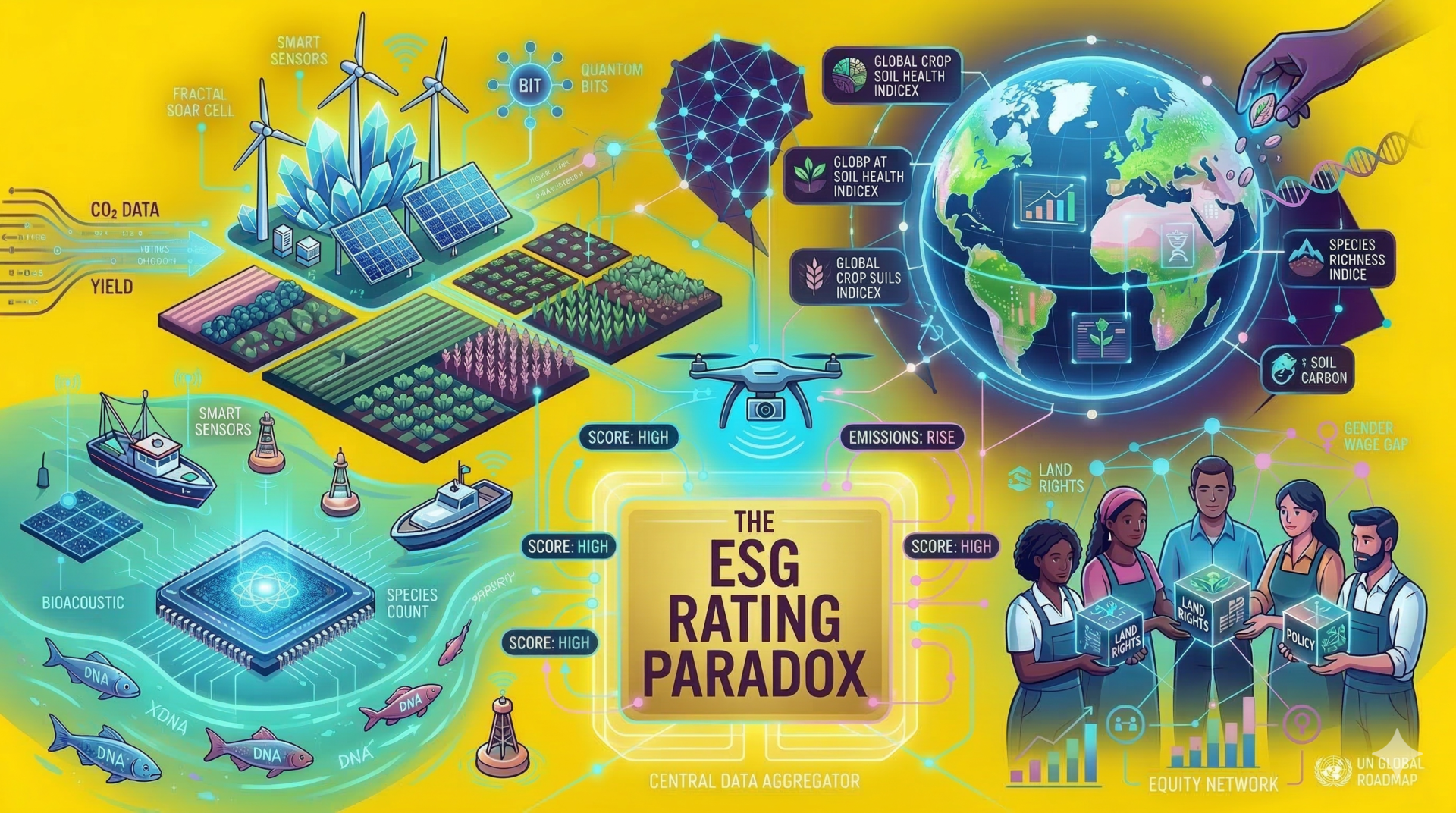
ESG ratings can give the same company very different scores. One provider may call a business an industry leader, while another places it near the bottom. That gap is not always an error. It usually reflects different questions, evidence, methods, and priorities.
For investors and companies, the disagreement can be confusing. However, it also reveals an important truth: an ESG score is an opinion built from a model, not a single objective fact. Understanding the model is therefore more useful than relying on the headline number alone.
Why ESG ratings disagree
ESG ratings disagree for three main reasons: scope, measurement, and weighting. Researchers call this the “aggregate confusion” problem. A major study of six rating agencies found that measurement differences explained most of the divergence, followed by differences in scope and weight.
In simple terms, providers do not always assess the same issues. Even when they do, they may use different indicators. Finally, they may assign different importance to each indicator. Small choices made across hundreds of data points can produce very different final ESG ratings.
1. Scope: providers ask different questions
One agency may focus on risks that environmental and social issues create for a company. Another may also consider the company’s impact on people and the planet. These are related ideas, but they are not identical.
Sector coverage varies too. For example, a technology company may be judged heavily on data privacy and workforce practices. An energy producer may receive more attention for emissions, water use, and safety. Providers choose different topics and boundaries, so their ESG ratings start from different foundations.
2. Measurement: the same issue, different evidence
Two agencies can examine carbon emissions yet reach different conclusions. One may reward a published reduction target. Another may give more weight to verified progress against that target. A third may compare emissions intensity with peers.
Data gaps make this harder. Companies disclose information in different formats, while some indicators are estimated. Providers may also use news reports, controversies, questionnaires, and alternative datasets. As a result, the evidence behind ESG ratings is rarely identical.
3. Weighting: priorities change the final score
After collecting data, each provider decides how much every issue matters. Governance may receive a large weight in one model. Climate risk or labour practices may dominate another. Those choices can change both the category scores and the final result.
Materiality also depends on the industry. Water use may be critical for mining or agriculture but less important for a software company. Sensible models reflect those differences. Still, providers define materiality in their own ways, which creates another source of variation.
What the correlation gap means
The correlation gap does not mean that every rating is useless. Instead, it means users must understand what each score is designed to measure. Comparing numbers without reading the methodology can create false confidence.
For instance, a strong risk-management score does not automatically prove that a company has a positive environmental impact. Likewise, a low score may reflect weak disclosure rather than poor performance. This distinction matters when evaluating the environmental, social, and governance pillars.
How investors should compare ESG ratings
- Define the decision. Decide whether you are assessing financial risk, real-world impact, values alignment, or stewardship priorities.
- Read the methodology. Check the provider’s scope, data sources, industry model, controversy rules, and weighting system.
- Examine the underlying indicators. A single score can hide strengths and weaknesses. Review emissions, safety, board oversight, labour practices, and other material measures separately.
- Compare several sources. When ESG ratings disagree, investigate why. The disagreement itself can identify missing data or contested assumptions.
- Verify company claims. Treat polished sustainability reports as evidence to test, not conclusions to accept. Our guide to spotting greenwashing offers practical checks.
How companies can respond
Companies cannot control every external model. However, they can improve the quality and consistency of their disclosures. Clear definitions, comparable time series, documented boundaries, and independent assurance make performance easier to assess.
Teams should also correct factual errors through formal provider channels. At the same time, they should avoid managing only for a score. Chasing one methodology can distort strategy and encourage superficial reporting instead of genuine improvement.
A better way to use ESG ratings
The best approach is to treat ESG ratings as one layer of analysis. Combine them with company filings, sustainability reports, controversy records, sector benchmarks, and direct engagement. The Aggregate Confusion study provides useful evidence on why rating systems diverge.
Most importantly, match the tool to the question. A rating designed to assess financial exposure should not be presented as a complete measure of social or environmental impact.
The bottom line
Different ESG ratings are not interchangeable. Their scores depend on what they cover, how they measure performance, and which issues they prioritise. Therefore, the right response is not to search for one “correct” number.
Instead, investors should look beneath the score, compare methodologies, and test the underlying evidence. Used carefully, ESG ratings can support better questions and sharper decisions. Used without context, they can create more certainty than the data deserves.