
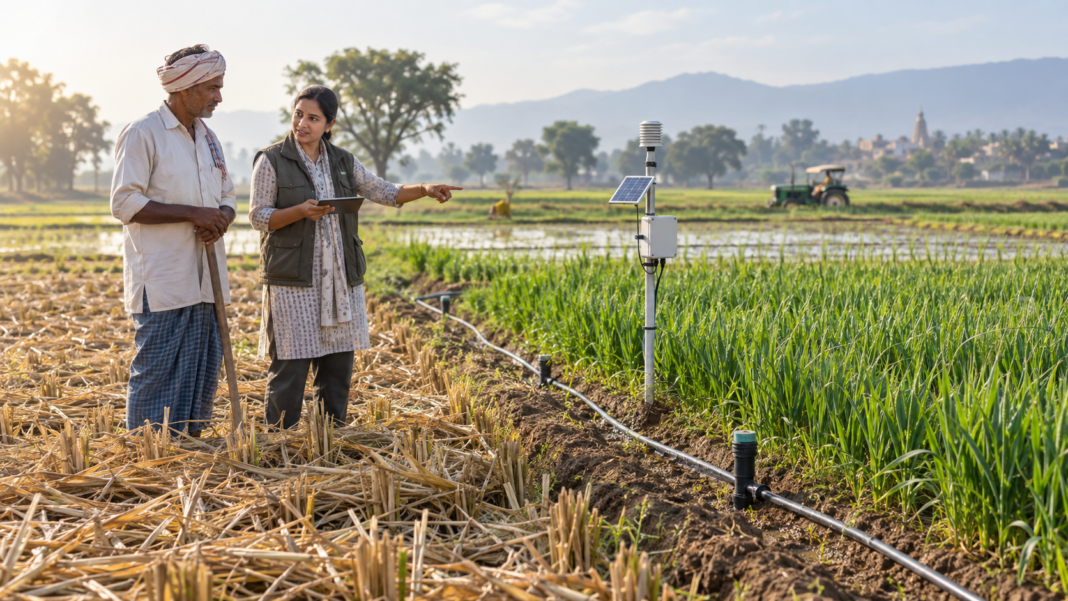

Climate-smart agriculture promises three gains at once: better farm productivity, stronger climate resilience, and lower greenhouse gas emissions. That is an appealing proposition for farmers, food companies, and investors. Yet a practice does not become a “triple win” simply because separate studies associate it with three desirable outcomes.
The practical question is narrower: were all three outcomes measured in the same farming system, over a useful period, and against a credible comparison? If not, the claim may still point in the right direction. It just says more than the evidence can support.
This distinction matters in India, where crop, soil, water, and market conditions can change across short distances. A sound program must fit the field before it fits the sustainability report.
What climate-smart agriculture is meant to deliver
The Food and Agriculture Organization describes climate-smart agriculture as a context-specific approach built around three linked goals:
- Sustainably increase agricultural productivity and incomes.
- Build resilience and support adaptation to climate change.
- Reduce or remove greenhouse gas emissions where possible.
The phrase “where possible” is important because climate-smart agriculture covers a range of practices whose benefits vary by place. A heat-tolerant seed may mainly protect yield, while better irrigation scheduling may conserve water and reduce energy use. Residue management can improve air quality as well as farm economics.
The problem begins when a program bundles several practices and reports all three outcomes without measuring each one.
Why climate-smart agriculture claims need testing
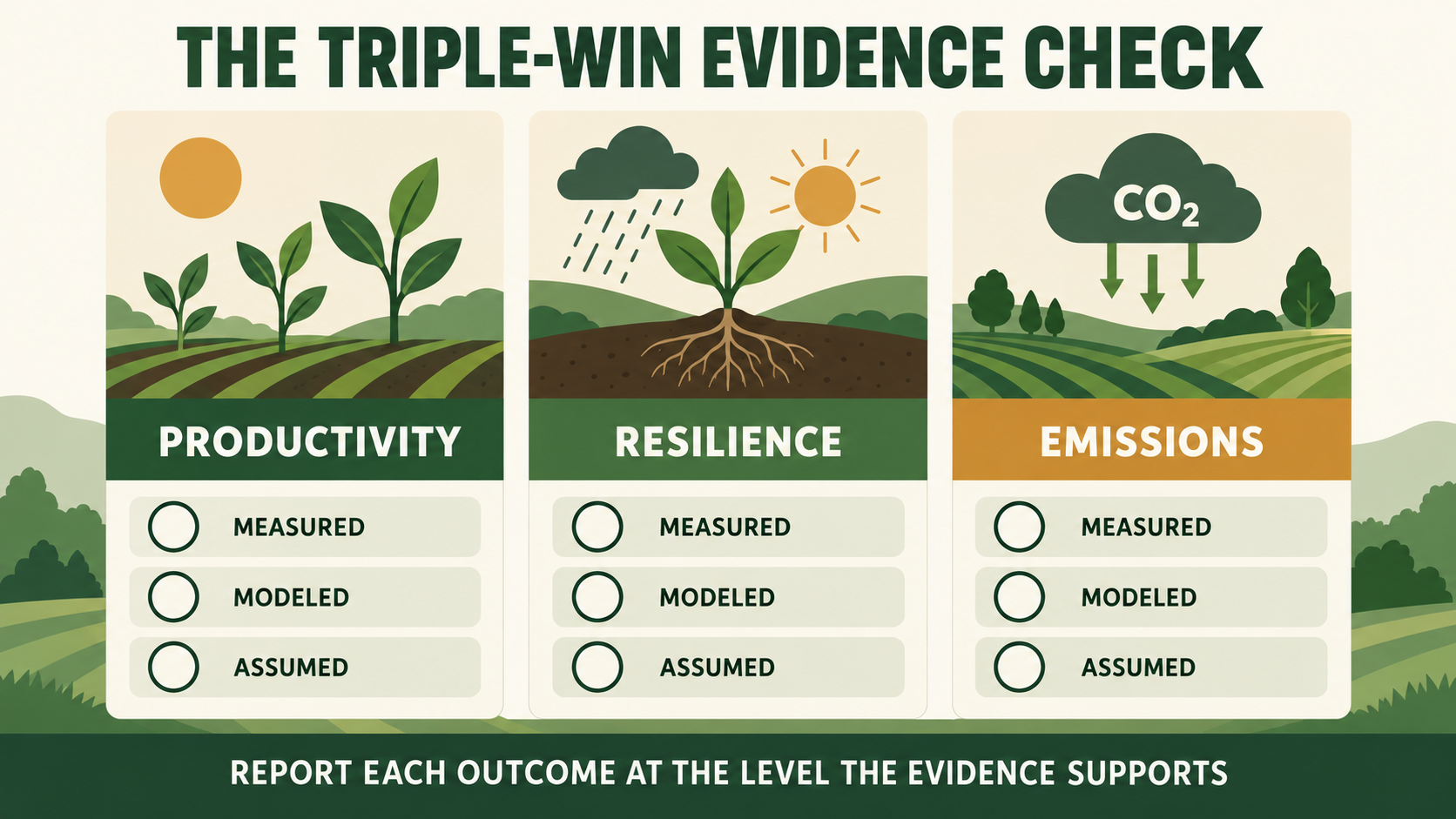
Productivity, resilience, and mitigation are different outcomes. Each needs its own indicator.
- Productivity could mean yield per hectare, net farm income, or output per unit of water.
- Resilience could mean a smaller yield loss during drought, faster recovery after a flood, or more stable income across seasons.
- Mitigation could mean lower fuel use, reduced fertilizer emissions, or a verified change in soil carbon.
An increase in yield does not prove resilience, and a resilience practice may have no direct effect on emissions. Modeled carbon benefits also carry a different level of evidence from changes measured in the field.
This is the central evidence problem. A large research base may support the three pillars separately, while very few studies test them together. Therefore, managers should treat the triple win as a hypothesis that still needs examination before it becomes a reported result.
A five-question evidence check
Before approving a climate-smart agriculture claim, ask five questions.
1. What exactly changed?
Name the intervention. “Regenerative practices” is too broad. Was it direct seeding, residue retention, crop rotation, reduced tillage, a cover crop, lower nitrogen use, or a combination?
Bundled labels hide causality. If results improve, the team cannot tell which component helped. If yields fall, it cannot tell which component needs adjustment.
2. What was measured?
Classify every reported result as measured, modeled, or assumed.
Measured results come from field records, samples, or sensors. Modeled results use measured inputs but depend on equations and assumptions. Assumed results borrow an effect from another study or region. All three can inform a decision, but they should never be presented as equivalent.
3. What is the comparison?
A credible result needs a baseline or control. Compare the new practice with the farm’s previous method, or use matched plots during the same season. Also record weather, soil type, irrigation, seed, fertilizer, and labor because these factors can overwhelm the practice effect.
4. How long was the test?
One season may reveal an immediate yield or cost effect. However, it cannot establish resilience, which requires exposure to stress, or a durable soil-carbon trend.
Soil carbon illustrates the timing problem. Research cited in the source chapter reports a field-scale minimum detectable change of about 2.7 metric tons of carbon per hectare. A global cover-crop meta-analysis found average accrual of about 0.56 metric tons per hectare per year. At those rates, a genuine gain may remain statistically difficult to detect on one field for roughly five years.
5. Who carries the transition risk?
New practices can demand equipment, training, labor, or temporary yield risk before benefits arrive. Record who pays those costs. A buyer’s expression of interest creates no premium by itself, and projected carbon-credit value becomes farm income only after payment reaches the farmer.
What climate-smart agriculture learns from residue management
For climate-smart agriculture in northwest India, rice-residue management offers a useful test. Burning clears a field quickly during the short interval between rice harvest and wheat sowing, but it creates severe air pollution and releases greenhouse gases.
A 2019 assessment compared ten residue-management options. Directly sowing wheat into standing rice residue performed strongly: the study estimated it was 10–20% more profitable than burning alternatives, adding roughly ₹6,000–₹11,500 per hectare. In addition, greenhouse gas emissions per hectare were more than 78% lower than under the burning options.
That is unusually persuasive evidence because it examines farm economics and emissions within the same decision. Still, it does not complete the triple win. Resilience was not quantified as a separate outcome.
The lesson is that the claim should match the measurement: higher profitability and lower emissions, with resilience still to be tested.
Treat carbon revenue with care
Within climate-smart agriculture programs, carbon farming can help finance better agricultural practice, but projected credit value should not lead the business case.
A study of 841 farmers across seven carbon projects in Haryana and Madhya Pradesh found that 99% of sampled farmers had received no carbon-credit payment at the time of the survey. Among participants, practice continuation also varied, and lack of monetary benefit was a major reason for stopping.
The result cannot be generalized to every project. However, it shows why program design must track both cash received by farmers and credits expected or issued. Retention should also be a core performance measure.
For each season, report:
- farmers and hectares enrolled;
- farmers and hectares that re-enrolled;
- payments promised and payments received;
- practices verified;
- exits and stated reasons for leaving.
Gross enrollment without exits can make a program appear larger than the area still under practice.
How AI can support climate-smart agriculture
AI can lower monitoring costs by combining several signals. For example, satellite imagery can flag crop cover or possible residue burning, while sensor and weather data can improve irrigation advice. Models can also estimate emissions from fuel, fertilizer, and field operations. Together, these tools help teams decide where to inspect and which farms need support.
They do not remove the need for ground truth. A model can misclassify a field, inherit a biased training set, or produce false precision when farm records are weak. Soil-carbon estimates remain sensitive to sampling depth, density, and the model’s assumptions.
Therefore, use AI as a triage and decision-support layer. Keep a documented chain from raw data to reported result, and label modeled outputs clearly.
The same discipline applies to biodiversity intelligence: technology makes monitoring more scalable, but field validation makes the claim credible.
A climate-smart agriculture pilot for Indian farms
Start with a defined block rather than a whole supply base.
- Choose one practice and one business objective.
- Record the baseline for yield, input use, cost, and relevant climate risk.
- Keep a comparable control plot or matched group.
- Set indicators for all three pillars, even if one will remain modeled.
- Run the pilot for at least three seasons; use a longer horizon for soil carbon.
- Review results with farmers before expanding the program.
- Publish measured, modeled, and assumed outcomes separately.
This approach gives managers evidence they can act on. It also protects farmers from being asked to absorb an unpriced transition risk.
GreenCentral’s agriculture practice coverage will continue to examine the practices, tools, and business models behind these claims. The broader Nature & AgriTech section connects them with water, soil, biodiversity, and food-system resilience.
The bottom line
Climate-smart agriculture works best as a decision framework. Begin with the farm problem, select a practice suited to local conditions, and measure productivity, resilience, and emissions separately. Then report only the outcomes the evidence can carry.
A two-part win is still valuable. A single, well-measured gain may justify adoption. In short, credibility comes from resisting the temptation to turn those results into a larger story than the field has proved.
Sources
- Food and Agriculture Organization of the United Nations, “Understanding Climate-Smart Agriculture.”
- P. Shyamsundar et al., “Fields on Fire: Alternatives to Crop Residue Burning in India,” Science 365 (2019), 536–538.
- A. A. G. Cariappa and V. V. Krishna, “Carbon Farming in India: Are the Existing Projects Inclusive, Additional, and Permanent?”, Climate Policy 25 (2025), 756–771.
- C. Deluz et al., “Evaluation of the Potential for Soil Organic Carbon Content Monitoring with Farmers,” Frontiers in Environmental Science 8 (2020), 113.
- J. Jian et al., “A Meta-analysis of Global Cropland Soil Carbon Changes Due to Cover Cropping,” Soil Biology and Biochemistry 143 (2020), 107735.