


The climate finance gap in emerging markets is not caused by a lack of useful projects alone. Many clean-energy and resilience assets have high upfront costs, long lives, and low fuel costs. When interest rates, currency risk, policy risk, and project risk are high, even proven technology can become too expensive to build.
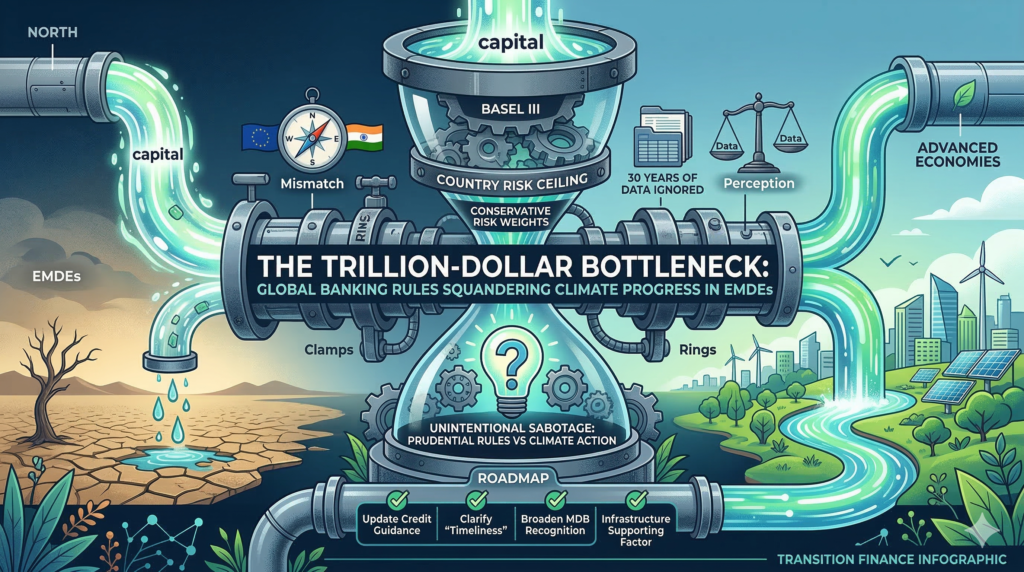
What the climate finance gap means
The gap is the difference between the capital needed for climate and development goals and the money that reaches viable projects. It includes clean power, grids, efficient buildings, transport, industry, adaptation, and nature.
Estimates vary because reports use different regions, years, and definitions. Some count total investment, while others count only extra climate spending or international flows. Therefore, any headline number needs a clear scope.
The IEA analysis on reducing the cost of capital says clean-energy investment in emerging and developing economies must rise sharply to meet national and global goals. It also shows how financing cost can form a large part of the final cost of power.
Why the climate finance gap persists
Investors price many risks. Country risk reflects macroeconomic, legal, and political conditions. Project risk includes construction, technology, revenue, and operating performance. Currency risk appears when debt is in dollars or euros but project income is in local money.
Small markets may have fewer lenders, shorter loan terms, and limited long-term local currency debt. In addition, weak grids or slow permits can delay revenue. Each layer raises the return that investors demand.
The IEA Cost of Capital Observatory tracks financing conditions for energy projects in emerging and developing economies. Its purpose is to improve data and help governments understand the risks behind high costs.
Currency and foreign-exchange risk
A solar plant may sell electricity in local currency while repaying foreign debt. If the local currency loses value, debt service rises in local terms. Long project lives make this risk hard to price.
Hedging can help, but long-term products may be costly or unavailable. Public or development institutions may offer guarantees, local currency loans, or risk-sharing tools. Yet support should target a clear market failure and avoid hiding weak project economics.
Domestic savings and capital markets can reduce the currency mismatch. Pension funds, insurers, and local banks may provide long-term funds when rules, pipelines, and risk controls are strong.
Policy and regulatory barriers
Clean-energy projects need stable rules for permits, grid access, tariffs, and contracts. Sudden policy change can damage investor trust. Likewise, state-owned buyers with weak finances may create payment risk.
Clear auctions and standard contracts can improve price discovery. Independent regulators and reliable dispute processes also help. However, low auction bids are not enough if projects fail to reach financial close or connect to the grid.
Governments should track delivery, not just announcements. A transparent project pipeline allows banks, contractors, and suppliers to prepare.
The missing project pipeline
Global investors often say they cannot find enough bankable projects at the scale they need. Early development work is costly and risky. Feasibility studies, land rights, permits, grid studies, and community engagement all need funds before construction finance arrives.
Project preparation facilities can cover part of this work. Standard documents and shared data may also reduce cost. For smaller assets, aggregation can combine many loans or projects into a portfolio.
Good preparation should not weaken safeguards. Environmental review, land rights, and local participation help prevent conflict and delay later.
Closing the climate finance gap with blended finance
Blended finance uses public or concessional funds to improve the risk-return profile of a project and attract private capital. Tools may include guarantees, first-loss capital, low-cost debt, insurance, or grants.
These tools work best when they address a specific risk. For example, a guarantee may cover a public buyer’s payment duty. A grant may fund early studies for a new market. Concessional finance should not replace policy reform or subsidize projects that private markets would fund anyway.
The IEA’s private-finance findings stress enabling policy, concessional capital, useful finance tools, and deeper local markets.
Green bonds and local capital
Green bonds can connect issuers with investors who want eligible environmental projects. However, the label does not remove credit risk. Investors still examine the issuer, use of proceeds, reporting, and project quality.
Local currency bonds can reduce foreign-exchange mismatch. Banks can also build loan products for rooftop solar, electric vehicles, efficient equipment, and resilient homes. Small loans need simple checks and low service costs.
GreenCentral explains the structure and safeguards of green bonds and sustainable finance in separate guides.
Adaptation finance remains harder
Many adaptation projects protect lives and assets but do not create a direct cash flow. A flood barrier, heat plan, or early-warning system may save large future losses without earning user fees.
Public budgets and concessional finance therefore play a larger role. Insurance can support recovery, but it does not replace risk reduction. Resilience bonds and outcome-based tools may help in some cases, though they need clear measures.
Project design should include vulnerable groups. Otherwise, new infrastructure may shift risk or leave the poorest people unprotected.
How investors can assess emerging-market climate projects
Start with revenue, contracts, and currency. Then test construction, grid, policy, and operating risk. Use realistic scenarios for rates, exchange moves, delays, and lower output.
Next, assess climate integrity. Check the emissions baseline, adaptation goal, and monitoring plan. A project can be financially sound yet have a weak environmental claim.
Finally, examine social and governance risks. Land, labor, procurement, and community issues can change both impact and returns.
A practical path to narrow the gap
Governments can improve rules, project preparation, grid plans, and data. Development banks can use guarantees and long-term finance where markets cannot bear key risks. Private investors can build local teams and accept project sizes that fit the market.
The climate finance gap will not close through one large fund. It needs many bankable projects, fair contracts, deep local markets, and targeted public support. When each tool addresses a real barrier, more capital can reach clean energy and resilience at a cost that communities can afford.




[…] The $1 Trillion Gap: Why Climate Capital Skips Emerging Markets […]
[…] The $1 Trillion Gap: Why Climate Capital Skips Emerging Markets […]
[…] The $1 Trillion Gap: Why Climate Capital Skips Emerging Markets […]
[…] The $1 Trillion Gap: Why Climate Capital Skips Emerging Markets […]