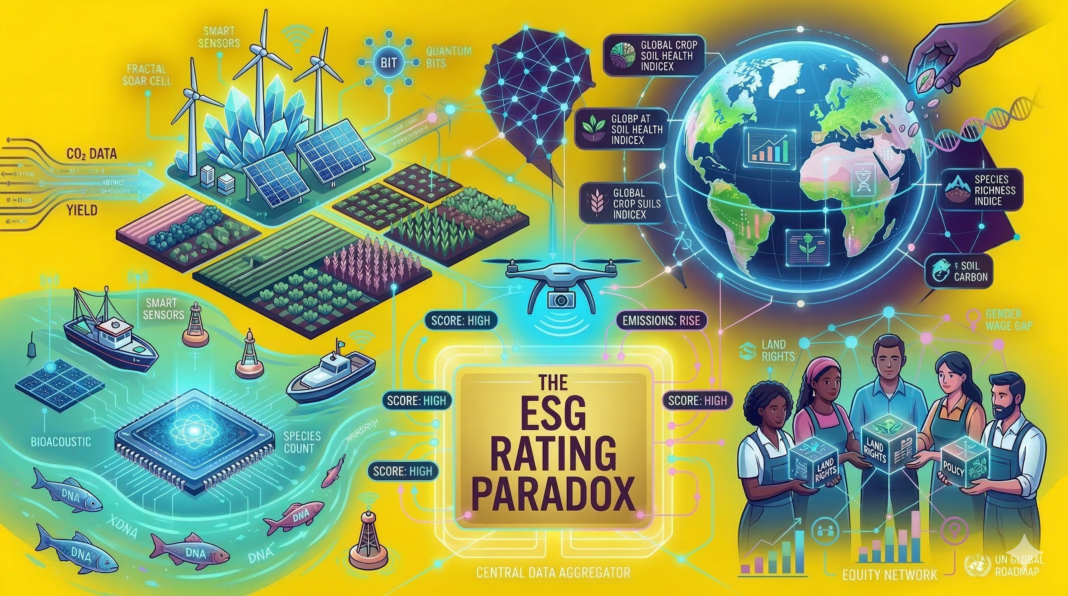

For years, the investment world has treated ESG (Environmental, Social, and Governance) ratings as a definitive North Star. We have accepted these letter grades and numerical scores as objective truths—scientific measurements of a company’s ethical health and long-term sustainability. However, as the industry matures, the uncomfortable reality is becoming impossible to ignore: the ESG ratings landscape is currently a “Wild West” of subjective methodologies and inconsistent data.
This issue is not merely a technical glitch in an otherwise sound system; it is a systemic failure that allows “ESG-labeled” funds to hold controversial assets without ever technically violating their mandates. We have built a multi-trillion-dollar investment movement on a foundation of proprietary guesswork. For the professional investor, the challenge is no longer just finding “green” companies, but navigating a dense fog of data where the same company can be a saint to one rater and a sinner to another.
To move beyond the marketing gloss, we must look at the structural inconsistencies that define the industry today.
The Great Correlation Gap
The most damning evidence of the instability in ESG ratings is what researchers call the “correlation gap.” In the traditional credit market, agencies like Moody’s and Fitch are almost always in lockstep. The correlation between their credit ratings is remarkably high—usually above 0.9—reflecting a global consensus on what constitutes financial risk.
In the ESG space, that consensus vanishes. Research by MIT Sloan and others has found that the correlation between major ESG rating providers ranges from 0.3 to 0.6. This divergence is not just a rounding error; it means a company could be rated “AAA” by MSCI while receiving a mediocre, middle-of-the-pack score from Sustainalytics.
This gap exists because of three specific levers that raters pull differently:
- Scope: This refers to which issues the rating agencies include in the evaluation. One rater might include carbon emissions and water usage, while another might ignore water but include executive pay.
- Measurement: This is how those issues are quantified. For example, how do you measure “labor relations”? Is it based on strike days, employee turnover, or the presence of a union policy?
- Weighting: The priority given to each issue. A rater might decide that, for a tech company, data privacy accounts for 50% of the score, while another might give it only 10%.
Without a common factual foundation, these ratings remain subjective opinions. This lack of rigor allows companies to “rating shop,” highlighting the one favorable grade that fits their narrative while ignoring the four others that do not.
Rewarding the “Talkers” Over the “Doers”
A significant structural flaw in current methodologies is the “disclosure problem.” Many major providers, such as Refinitiv and S&P Global, heavily reward the quantity and sophistication of a company’s reporting rather than its actual environmental or social performance.
Refinitiv’s model, for example, often rewards companies simply for the volume of data they disclose on a percentile basis within their peer group. Similarly, S&P Global’s Corporate Sustainability Assessment (CSA) relies on exhaustive annual questionnaires. This approach creates a perverse incentive: it turns ESG into a communications arms race. A multinational with a massive sustainability communications team can navigate these questionnaires to secure a high score. At the same time, a smaller firm with superior environmental practices but fewer “report-writers” is penalized.
We must also distinguish between types of providers. While Bloomberg acts primarily as a data aggregator—scoring the breadth of disclosure rather than underlying performance—organizations like CDP (formerly the Carbon Disclosure Project) are often considered the “gold standard” because they demand deep, specific data on climate and water.
Compounding this is the “rear-view mirror” problem. Most ESG ratings are backward-looking, relying on data from previous years. This approach penalizes companies undergoing genuine, forward-looking transformations. A legacy utility company pivoting aggressively to renewables may still be dragged down by its historical coal footprint, even if its current strategy is more sustainable than a “green” rival that is stagnating.
The Danger of the “Frankenstein” Score
The industry’s habit of rolling E, S, and G metrics into a single composite grade—a “Frankenstein” score—often obscures more than it reveals. By aggregating these three distinct pillars, critical trade-offs are not clear to the investors.
Consider a mining company that is a major environmental polluter but has a highly diverse board and impeccable accounting practices. Because the Governance (G) score is stellar, it can bolster the overall grade, masking the severe Environmental (E) risk.
This anomaly is why many sophisticated analysts are calling for the “Separation of Pillars.” An investor specifically focused on climate risk doesn’t benefit from having that risk blended with a company’s labor practices. A single letter grade implies a level of precision and comparability that does not exist. We need to see the raw performance of each category, free from the distortions of a composite average.
The 2008 Echo: Conflicts of Interest
The ESG rating industry faces structural risks that uncomfortably mirror the pre-2008 credit rating crisis. A primary concern is the conflict of interest inherent in the business model: many raters offer lucrative consulting or advisory services to the very companies they grade.
This nexus creates a “subtle pressure” to inflate ratings for paying clients. If a firm gets paid to help a company improve its ESG strategy, it is fundamentally difficult for that same firm to remain an impartial judge of the results. This lack of independence undermines the integrity of the entire ecosystem.
Regulators are finally taking notice. The EU has proposed regulations that would mandate the separation of advisory and rating activities. Similar debates are gaining momentum in the UK and Asia, as global markets realize that the current “pay-to-play” potential is a systemic risk that could lead to the same type of market blindness seen two decades ago.
From Policy to Outcomes: The Future Fix
The most promising path forward lies in a shift toward “outcome-based metrics.” Currently, many ratings are process-oriented—they measure whether a company has a written policy on climate change or human rights.
The future “gold standard” must prioritize actual results over corporate intentions:
- Actual carbon emissions (Scope 1, 2, and 3) rather than climate policy statements.
- Actual injury rates rather than the presence of health and safety manuals.
- Actual diversity outcomes in senior leadership rather than vague diversity goals.
By moving the needle from what companies say to what they actually achieve, we can finally provide investors with a signal quality that reflects real-world impact.
Beyond the Letter Grade
While the current ESG rating system is undeniably flawed, the “direction of travel” is positive. The emergence of standardized disclosure frameworks—such as the International Sustainability Standards Board (ISSB) and the EU’s Corporate Sustainability Reporting Directive (CSRD)—suggests that we are moving toward a common factual foundation. These regulations will eventually require third-party verification, treating sustainability data with the same audit-level rigor as financial data.
However, until these reforms take full effect, we must remain skeptical of the easy answer. A high ESG rating is not a certificate of virtue; it is a proprietary data point built on specific, often biased, assumptions. As professionals, we must ask: should we ever trust a single letter grade to define a company’s ethical soul or its long-term resilience?
The answer is clear: a rating is the beginning of the research process, not its end. It is time to look beneath the surface.