
Introduction
The climate crisis stands as one of humanity’s most pressing challenges. With global temperatures rising, extreme weather events becoming more frequent, and ecosystems under unprecedented stress, the need for innovative solutions has never been more urgent. Enter artificial intelligence and machine learning—technologies that are rapidly transforming how we approach climate change mitigation and adaptation.
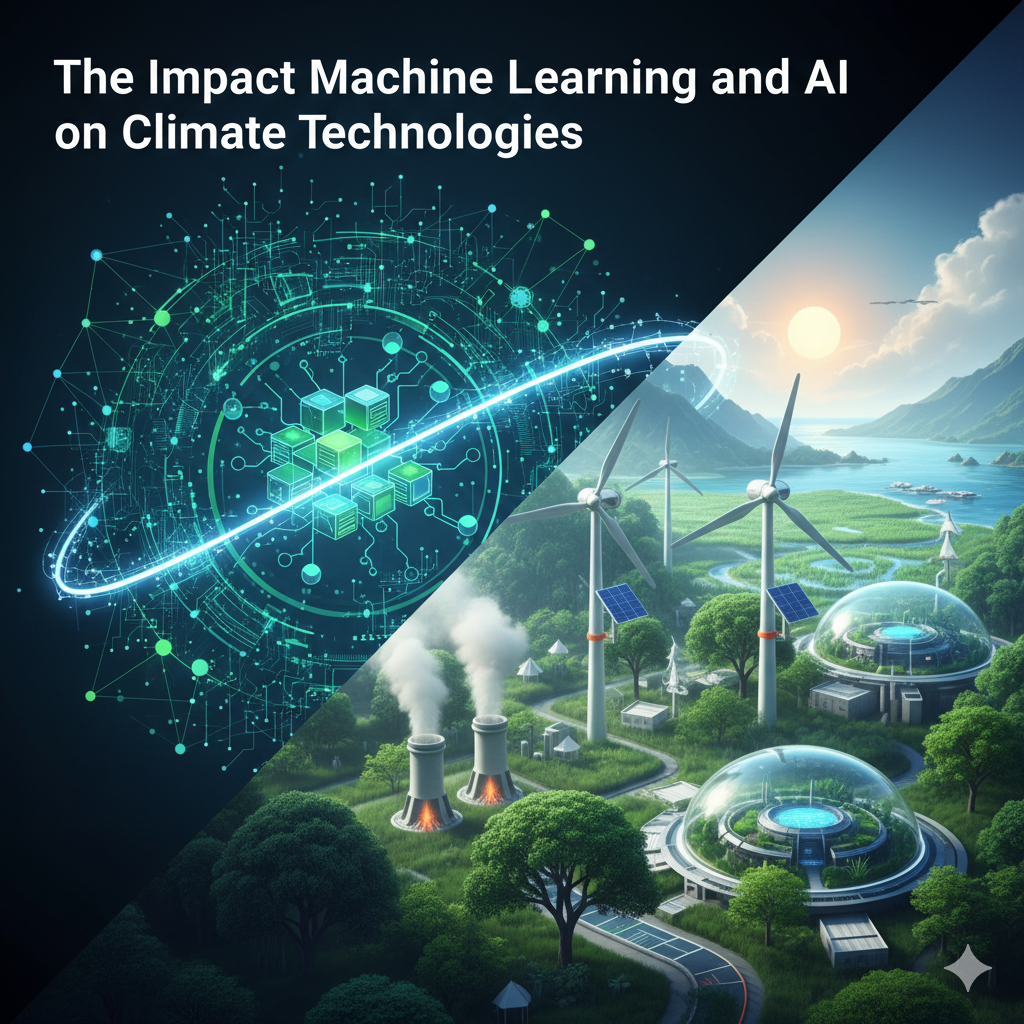
While AI alone cannot solve the climate crisis, it has emerged as a powerful accelerator for climate technologies across multiple sectors. From optimizing renewable energy systems to discovering new materials for carbon capture, AI is helping scientists, engineers, and policymakers make faster, smarter decisions in the race against time$1Indeed, this blog post explores how machine learning is reshaping climate technology and creating new pathways toward a sustainable future.
Machine Learning in Energy Systems and Grid Optimization
The transition to renewable energy is one of our most critical climate strategies, and AI is proving instrumental in making it both feasible and efficient. Unlike traditional fossil-fuel power plants, which can adjust output on demand, renewable sources like solar and wind are inherently variable—the sun doesn’t always shine, and the wind doesn’t always blow.
Renewable Energy Forecasting: Modern AI systems can predict solar and wind power generation with remarkable accuracy by analyzing weather patterns, historical data, satellite imagery, and atmospheric conditions$1Furthermore, these forecasts help grid operators plan, ensuring they have backup power sources ready when renewable generation dips. Google’s DeepMind, for instance, demonstrated that machine learning could predict wind power output 36 hours in advance, boosting the value of wind energy by roughly 20%.
Smart Grid Management: The electrical grid of the future will be vastly more complex than today’s infrastructure, with millions of distributed energy sources, including rooftop solar panels, electric vehicles, and battery storage systems$1Specifically, AI algorithms process data from countless sensors across the grid in real-time, automatically balancing supply and demand, rerouting power, and preventing outages$1Indeed, this intelligent orchestration minimizes waste and maximizes the integration of renewable energy.
Energy Storage Optimization: Battery storage is crucial for renewable energy’s viability, but determining when to charge and discharge batteries for maximum efficiency and longevity is incredibly complex$1Furthermore, machine learning models optimize these decisions by predicting energy prices, demand patterns, and grid conditions, thereby improving battery utilization and extending their operational lifespan.
Reducing Curtailment: One of renewable energy’s persistent problems is curtailment—shutting down wind turbines or solar farms despite favorable conditions because the grid cannot absorb excess power$1Specifically, AI helps minimize curtailment by predicting these situations in advance and coordinating with energy storage systems, flexible loads, and neighboring grid regions to utilize every kilowatt-hour of clean energy generated.
Machine Learning for Climate Modeling and Prediction
Understanding Earth’s climate system requires processing astronomical amounts of data and running extraordinarily complex simulations. Traditional climate models, while sophisticated, are computationally expensive and can take weeks or months to run. Machine learning is revolutionizing this field by both accelerating existing models and discovering new patterns that scientists might otherwise miss.
Enhanced Climate Simulations: AI can emulate complex climate models at a fraction of the computational cost, allowing researchers to run thousands of scenarios quickly and explore more variables. Neural networks trained on high-resolution climate data can produce detailed regional climate projections that would be prohibitively expensive with traditional methods. This process enables better planning for local climate impacts and adaptation strategies.
Extreme Weather Event Prediction: Machine learning models are becoming increasingly adept at predicting hurricanes, floods, droughts, and heat waves with greater accuracy and longer lead times$1Accordingly, by identifying subtle patterns in atmospheric and oceanic data, these systems can provide communities with earlier warnings, potentially saving lives and reducing economic damage. AI has shown particular promise in predicting the rapid intensification of hurricanes—a phenomenon that has become more common as oceans warm.
Carbon Cycle Modeling: Understanding how carbon moves through the atmosphere, oceans, forests, and soil is fundamental to climate science. Machine learning helps researchers track these complex flows by analyzing satellite data, ocean sensor readings, and ecosystem measurements$1Furthermore, these insights are crucial for assessing the effectiveness of carbon sequestration strategies and predicting future atmospheric CO2 concentrations.
Accelerating Research: Perhaps most significantly, AI is compressing the timeline of climate research itself. Tasks that once took teams of scientists months—such as analyzing satellite imagery for land-use changes or identifying patterns in ice-core data—can now be completed in days or even hours. This acceleration means we can understand and respond to climate change faster than ever before.
Machine Learning in Carbon Capture and Emissions Reduction
Reducing carbon emissions is essential, but so is removing CO2 that’s already in the atmosphere. AI is proving valuable on both fronts, from designing better carbon capture technologies to monitoring and reducing emissions across industries.
AI-Designed Materials for Carbon Capture: Discovering new materials that can efficiently capture carbon dioxide is like searching for a needle in a haystack—there are countless possible molecular configurations to explore. Machine learning dramatically accelerates this process by predicting which materials will have the desired properties without requiring scientists to synthesize and test each one physically. Researchers have used AI to identify promising metal-organic frameworks (MOFs) and other materials that could significantly improve the efficiency and cost-effectiveness of carbon capture.
Optimizing Industrial Processes: Heavy industries like cement, steel, and chemical manufacturing are major carbon emitters. AI systems analyze production data to identify inefficiencies and optimize processes for lower emissions without sacrificing output$1Furthermore, in some cases, machine learning has helped factories reduce energy consumption by 10-40% by fine-tuning variables such as temperature, pressure, and timing across production cycles.
Monitoring and Verifying Carbon Offsets: The carbon offset market depends on accurate measurement and verification, but tracking whether forests are actually sequestering promised carbon or whether emissions reductions are genuine has been challenging. AI analyzes satellite imagery, combines it with ground sensor data, and provides transparent, verifiable measurements of carbon storage and emissions. This process builds trust in carbon markets and ensures offset projects deliver real climate benefits.
Leak Detection: Methane leaks from oil and gas infrastructure are a significant but often invisible source of greenhouse gas emissions. Machine learning algorithms process data from satellites, drones, and sensors to detect these leaks quickly—sometimes identifying problems that would have gone unnoticed for months or years. Since methane is roughly 80 times more potent than CO2 over 20 years, stopping these leaks has an outsized climate impact.
Agriculture and Land Use
Agriculture contributes roughly a quarter of global greenhouse gas emissions while simultaneously being highly vulnerable to climate change. AI is helping transform farming into a more sustainable, climate-friendly enterprise while improving food security.
Precision Agriculture: Rather than treating entire fields uniformly, precision agriculture uses AI to analyze data from soil sensors, drones, and satellites to determine exactly where and when to apply water, fertilizer, and pesticides. This targeted approach dramatically reduces resource use and associated emissions. Machine learning models can determine the optimal irrigation schedule for each field section based on soil moisture, weather forecasts, and crop growth stage, potentially reducing water use by 20-30% while maintaining or improving yields.
Crop Yield Prediction and Climate Adaptation: AI helps farmers and policymakers anticipate harvests and plan for climate-related disruptions. By analyzing weather patterns, soil conditions, and historical data, machine learning models can predict yields months in advance and identify which crop varieties will perform best under changing climate conditions. This information is crucial for food security planning and helping farmers adapt to new climate realities.
Deforestation Monitoring: Forests are critical carbon sinks, but tracking illegal logging and deforestation across vast areas has been nearly impossible with manual methods. AI systems analyze satellite imagery in near real-time, automatically detecting forest loss and alerting authorities to potential illegal activity. Global Forest Watch and similar platforms use machine learning to monitor hundreds of millions of acres, providing transparency and enabling rapid response to deforestation.
Soil Carbon Sequestration: Healthy soils can store enormous amounts of carbon, but managing them for maximum sequestration requires understanding complex interactions between soil microbes, organic matter, farming practices, and environmental conditions. Machine learning helps optimize practices like cover cropping, reduced tillage, and crop rotation to maximize soil carbon storage while maintaining agricultural productivity.
Transportation and Urban Planning
Transportation accounts for a significant share of global emissions, and how we design our cities shapes energy consumption for decades to come. AI is driving improvements across both domains.
electric vehicle Battery Optimization: The performance and longevity of EV batteries depend on sophisticated management systems that optimize charging and discharging patterns. Machine learning algorithms learn each battery’s unique characteristics and adjust operation to extend range, reduce degradation, and maximize lifespan. Some AI systems can predict battery failures before they occur, preventing breakdowns and reducing waste. Additionally, AI optimizes charging times to capitalize on periods when renewable energy is abundant on the grid, thereby indirectly reducing the carbon footprint of electric transportation.
Traffic Flow and Route Optimization: Transportation-related emissions aren’t just about vehicle technology—they’re also about how efficiently vehicles move. AI-powered traffic management systems reduce congestion by optimizing signal timing, predicting bottlenecks, and suggesting alternative routes. Google Maps and similar services use machine learning to route millions of drivers more efficiently, collectively saving fuel and reducing emissions. Studies suggest AI-optimized traffic systems can reduce congestion-related emissions by 15-20% in urban areas.
Smart City Design: Planning sustainable cities requires analyzing countless variables—population density, building placement, public transit routes, green space distribution, energy systems, and more. AI helps urban planners simulate different development scenarios and their climate impacts, identifying designs that minimize emissions while maximizing livability. Machine learning can optimize everything from building orientations for passive solar heating to the placement of district heating networks.
Public Transit Optimization: Getting people out of private vehicles and into public transportation is crucial for reducing urban emissions, but transit systems must be convenient and reliable to compete with cars. AI optimizes bus and train schedules based on real-time demand, predicts maintenance needs to prevent service disruptions, and helps agencies design routes that serve the most people most efficiently. When public transit works well, it works for the climate.
Challenges and Considerations
While AI offers tremendous potential for addressing climate change, we must also grapple with its limitations and unintended consequences.
AI’s Own Carbon Footprint: Training large AI models requires enormous computational power, resulting in significant energy consumption and carbon emissions. A single training run for a large language model can emit as much CO2 as several cars over their entire lifetimes$1Notably, as we deploy AI for climate solutions, we must be mindful of this footprint and prioritize energy-efficient algorithms, renewable-powered data centers, and careful consideration of whether the climate benefits genuinely outweigh the computational costs. Not every problem requires the largest, most complex AI system.
Data Availability and Quality: Machine learning is only as good as the data it’s trained on, and climate-related data presents unique challenges. Weather stations and sensors are unevenly distributed globally, with much of the developing world lacking comprehensive coverage. Historical climate data may contain biases or gaps. Satellite coverage is improving, but it still has limitations. Poor data quality can lead to AI systems that work well in data-rich regions but fail elsewhere—potentially exacerbating climate inequality.
Need for Interdisciplinary Collaboration: Solving climate problems with AI requires bringing together climate scientists, machine learning experts, policymakers, engineers, and domain specialists. These groups often speak different languages and work in different institutional contexts. A climate scientist might understand atmospheric physics deeply but lack the machine learning expertise to apply advanced algorithms. Conversely, an AI researcher might build technically impressive models without understanding the nuances of climate science that make them useful. Effective climate AI requires breaking down these silos.
Ethical Considerations and Equitable Access: The benefits of climate AI must reach those most vulnerable to climate change, not just wealthy nations and corporations. There’s a risk that AI-optimized renewable energy, precision agriculture, and climate adaptation tools remain accessible only to those who can afford them, widening global inequalities. Additionally, AI systems trained primarily on data from developed nations might not work well in different contexts, potentially leading to inappropriate recommendations for developing regions. Ensuring equitable access and culturally appropriate applications of climate AI must be a priority.
Conclusion
Artificial intelligence and machine learning are not silver bullets for climate change, but they are powerful tools that can accelerate our transition to a sustainable future. From optimizing renewable energy grids to discovering new carbon capture materials, from protecting forests to designing climate-resilient cities, AI is expanding what’s possible in climate technology.
However, technology alone will never be sufficient. AI must work in concert with bold policy decisions, significant investments in clean infrastructure, changes in consumption patterns, and a fundamental reimagining of our relationship with the natural world. Machine learning can tell us the optimal placement for wind turbines, but it cannot create the political will to build them$1Consequently, it can identify deforestation, but it cannot address the economic pressures that drive people to cut down trees.
The most promising future is one where we harness AI’s capabilities while remaining clear-eyed about its limitations. We must deploy these tools thoughtfully, ensuring they serve climate justice and reach those most affected by climate change. We must invest in making AI itself more sustainable, reducing the carbon footprint of computation even as we expand its applications.
The climate crisis demands urgent action and unprecedented innovation. Machine learning gives us new capabilities to meet this moment—the ability to process vast amounts of data, optimize complex systems, discover hidden patterns, and make faster decisions. As we race against time to limit warming and adapt to the changes already underway, AI is one of many essential tools in our arsenal.
The question is not whether AI can help address climate change—it clearly can$1Moreover, the question is whether we will deploy it wisely, equitably, and swiftly enough to make a difference when it matters most$1Moreover, the window for action is narrowing, but with the right combination of technology, policy, and collective will, a sustainable future remains within reach.